

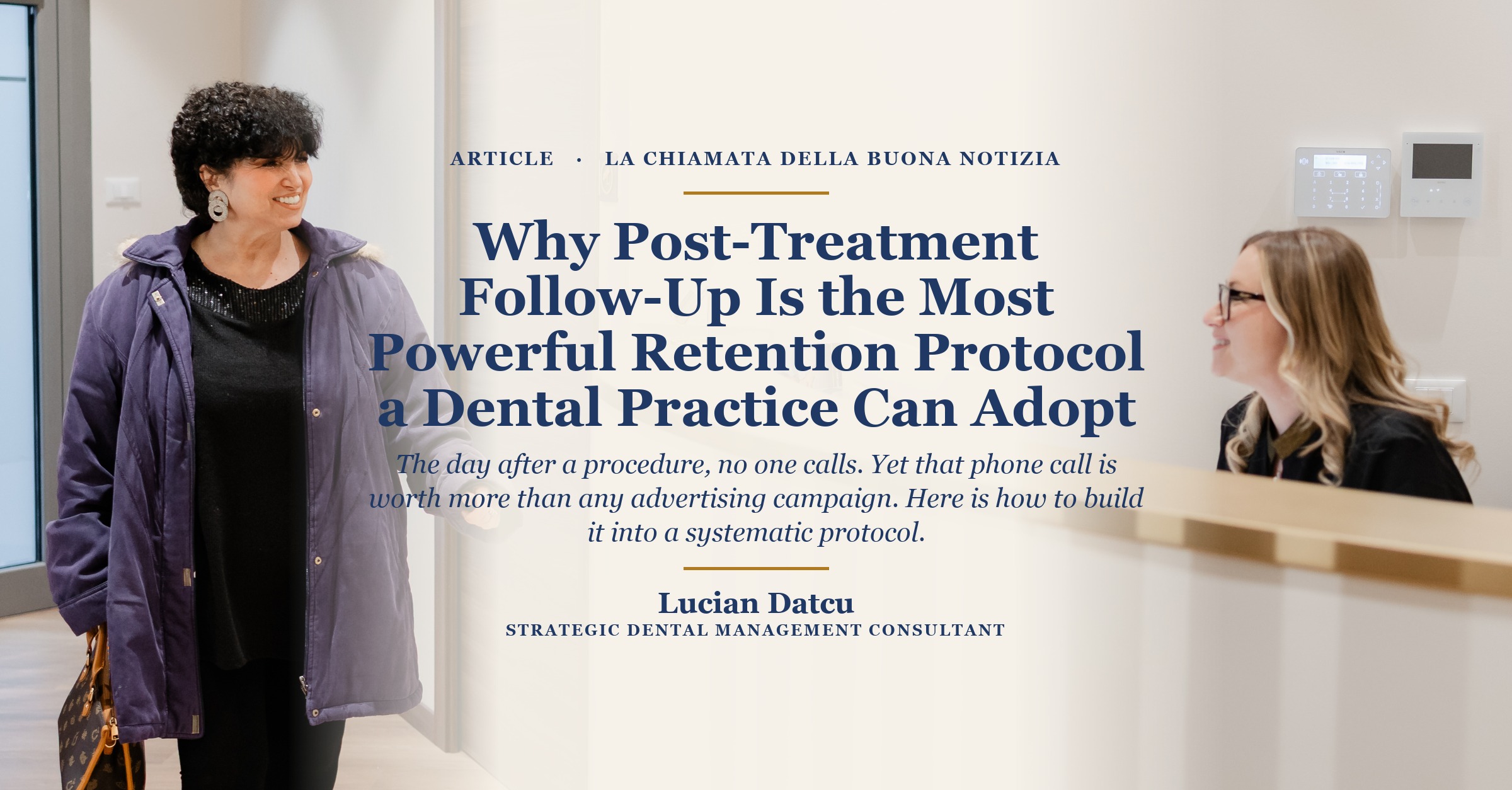
The patient who completed a significant procedure yesterday is at home today, alone with their own sensations: a swelling they cannot tell is normal, a question they did not dare ask in the chair, a small uncertainty that grows in the hours that follow.
If their phone rings at that moment and someone from the practice is calling to ask how they are doing, something precise and measurable happens: trust is reinforced, the perceived value of the treatment journey rises, and the likelihood that patient becomes an ambassador for the practice increases significantly. Yet in most of the Italian dental practices I work alongside, that call does not happen. Or it happens sporadically, left to individual goodwill, with no protocol, no designated person and no defined time. It exists, in other words, as a gesture rather than a system.
In dentistry, clinical quality cannot be assessed directly by the patient. This is a structural fact, not a matter of opinion. The patient cannot judge the precision of a filling, the quality of an implant placement or the skill with which a complex extraction was carried out. What they can judge, with remarkable accuracy, is the quality of the relationship: how they were welcomed, how they experienced the presentation of the treatment plan, whether they sensed attentiveness or haste, and above all what happened after they left the practice. The post-procedure moment is a relational void that almost no principal is aware of having created, yet the patient perceives it with absolute clarity.
In the practices I work with, when I raise the subject of post-treatment follow-up, I almost invariably encounter the same response: "We do it when we can." That phrase captures the problem precisely. A gesture done "when we can" is not a protocol: it is an intention, and intentions cannot be measured, improved or delegated. A protocol, on the other hand, has a clear owner, a fixed moment in the day, a defined script and a register where it is recorded. The difference between the two approaches is not one of human quality but of process engineering. And that difference, over the medium term, produces concrete and measurable economic results.
Word of mouth remains, for the overwhelming majority of high-quality Italian dental practices, the primary source of new patient acquisition. This is confirmed by sector observations published on Odontoiatria33 and by recurring surveys conducted among practitioners: when a patient recounts their experience at the dentist, several seemingly incidental factors shape that account, but the sense of care and attention received after the appointment holds a central place. Now, word of mouth does not stem from the clinical procedure itself, which the patient cannot evaluate on its technical merits. It stems from the overall emotional experience, of which the post-procedure follow-up is the most powerful closing note. A patient who receives a check-in call the day after does not merely remember the practice favourably: they have something specific to recount. That call becomes the content of their word of mouth.
The very name I give this protocol in the practices I support is deliberate. "Good news" because the tone of the call is not that of a formal clinical check or an administrative verification: it is that of someone from the practice bringing attention and reassurance. It is not the call of an assistant reading from a script. It is the call of the Concierge, or Patient Wellbeing Manager, who already knows the patient, knows their name, understands the journey they have been through and is calling because she genuinely wants to know how they are doing. This distinction in tone is fundamental: a call perceived as procedural does not produce the relational effects described above; one perceived as genuine does.
The protocol rests on three invariable elements.
Ownership: The call does not fall to the clinician or the receptionist. It belongs to the Concierge, who has already built a relationship with the patient during the pre-visit phase. This continuity in the relationship is part of the protocol, not an incidental detail.
Timing: The call takes place the day after the procedure, within a defined time slot that is booked into the diary as any other practice activity would be. Not "when we can", but in a precise slot that forms part of the Concierge's operational day.
Content: The patient is asked how they are feeling, any questions or concerns are addressed, they are reassured about what is normal to expect in the post-operative period and the next point of contact is confirmed in advance. Nothing is sold, nothing is proposed: the practice is simply present.
Announcing the call before the patient leaves the practice is an integral part of the protocol. This is the detail almost everyone overlooks. When the Concierge, before the patient walks out, says: "I will have the pleasure of speaking with you tomorrow to see how you are getting on", two things happen simultaneously:
The patient knows the call is coming, and the anticipation of that contact already shifts their perception of the experience.
The call is no longer an unexpected gesture that risks being read as unusual, but the fulfilment of a promise made, carrying all the trust that follows from that. An announced call is worth twice as much as an unexpected one.
Tracking is the element that turns the call into a system. Every contact made must be logged with the date, the patient's name, a brief summary of the conversation and the outcome. Not for the sake of bureaucracy, but because what is not measured cannot be improved.
In the practices I support, the post-treatment follow-up protocol sits within a broader logic: that of the maintenance plan integrated into the treatment journey from the moment of acceptance. When a patient accepts a significant treatment plan, maintenance is not an option to be proposed at a later stage but a part already built into the pathway, with hygiene appointments and check-ups planned over time. The call the day after is the first contact within this long-term plan: it signals to the patient that the relationship with the practice does not end with the final payment, but continues.
This has precise organisational consequences. The number of active patients, meaning those engaged in a sustained pathway rather than lost after treatment, grows in a structural way. Medium-term diary predictability improves, because recall appointments no longer depend on ad hoc campaigns but on an already planned flow. And qualified word of mouth, the kind that brings in patients already predisposed to accepting high-value treatment plans, increases because it is fed by concrete experiences worth sharing.
The Concierge cannot make the call if she does not have her own diary, if a dedicated slot is missing, if she has not been trained on the content of that conversation, and if there is no tracking system that makes the gesture visible and measurable. The protocol requires the entire surrounding structure to already be aligned: from the moment the patient books their first visit to the financial agreement, from the presentation of the treatment plan to the management of recall appointments over time.
This is the central issue in every engagement I carry out within a practice: no tactic, however effective, produces stable results when applied to an unstructured organisational system. The good news call works when it is the final piece of a patient protocol built with rigour from the very beginning to the very end of the journey. And it is precisely there, in the construction of that system, that the difference lies between a practice that works well and one that is autonomous, profitable and capable of growing without everything depending on the personal presence and energy of the principal.
If you want to understand how to structure the post-treatment follow-up protocol within a complete organisational system and assess where your practice currently stands in relation to this architecture, you will find on the website a detailed description of the support method and a point of contact to begin a concrete analysis.
Datcu Lucian
Strategic Dental Management Consultant
For over a decade I have worked alongside dental practices that want to lead on quality and become the point of reference in their area.
Lucian Datcu
Strategic Dental Management Consultant
For over a decade I have worked alongside excellent dental practices that choose to compete on quality, to become the undisputed reference point in their area.

Lucian Datcu Consulting
IFZA Properties, DSO-IFZA, Dubai Silicon Oasis, Dubai 342001, U.A.E - 104336951900001